
Checking Criminal History in Charlotte
A Charlotte record search starts with the kind of file, not a presumed city department. The current official Charlotte and MTAS rosters list no city police chief, police department, municipal judge, or court clerk. Dickson County General Sessions, by contrast, states that it serves Charlotte. This supports a county route for criminal law enforcement and court records, but it remains an evidence-based inference from current published sources, not proof that no special arrangement could ever exist.
Use this five-step Charlotte process:
- Ask the Dickson County Sheriff's Office whether it created or holds the Charlotte incident or arrest report.
- Call the county jail for a booking number, received charge, bond, custody status, release, or transfer.
- Contact General Sessions for the complaint, warrant-linked case, first appearance, misdemeanor action, or early felony record.
- Contact Circuit Court for an indictment, later felony docket, final judgment, sentence, or appeal from a lower court.
- Use TBI TORIS for a Tennessee repository result, then verify the match against the Charlotte county court files.
Charlotte Criminal Records Are County Files
Charlotte differs from Dickson and White Bluff because the official municipal sources do not publish a city police or municipal court channel. County General Sessions expressly names Charlotte among the cities it serves. The sound conclusion is that current Charlotte criminal records route through county agencies rather than a city police or court portal. Treat that statement as a research-supported inference and confirm unusual matters with Charlotte City Hall.
The Dickson County Sheriff's Office is the documented law-enforcement starting point.

The sheriff source fits Charlotte's county-centered record path and should not be mislabeled as a Charlotte city police department.
This distinction also prevents a false claim. There is no basis in the research for inventing a Charlotte Police Department, police chief, crime blotter, app, city arrest portal, municipal judge, or city court clerk. County data should likewise be labeled as county-jurisdiction data, not “Charlotte crime” data.
Charlotte Police Department Records
No Charlotte Police Department is listed in the current official municipal and MTAS rosters. General Sessions says it serves Charlotte officers, which supports using the Dickson County Sheriff and county courts for current Charlotte criminal matters. This is an inference from the published government record, not a claim that no city-specific arrangement can ever exist. City Hall can confirm the current routing when the creating agency is uncertain.
For a sheriff-created Charlotte report, use the sheriff's records channel. Public Records Request Coordinator Barbara Poppendorf is listed at P.O. Box 177, Charlotte, TN 37036, with phone (615) 740-4854, fax (615) 789-4185, and RecordsRequests@dicksoncosheriff.gov. Identify the event date, Charlotte location, involved names, incident or booking number, and exact record type.
Inspection-only requests may be oral under the sheriff's policy. Copy or inspection-plus-copy requests use Form 1. The policy allows proof of Tennessee citizenship, requires a written response within seven business days when prompt production is impracticable, and permits redaction or denial when law protects the content.
Four Charlotte Criminal Record Addresses
Charlotte's justice system is unusually compact. Four nearby addresses separate city administration, county courts, prosecution, and custody. Going to the wrong counter can delay a record request even when the buildings are close.
| Charlotte location | Record role |
|---|---|
| 22 Court Square | Charlotte City Hall and Recorder for city administrative records, not criminal dockets |
| 500 Spring Street | General Sessions and Circuit Court criminal files at the Justice Center |
| 604 Spring Street | 23rd Judicial District Attorney's Charlotte criminal office, not the general court-record custodian |
| 140 County Jail Drive | Dickson County Sheriff's Office and jail reports, booking, and custody information |
The short distance between these Charlotte offices does not merge their files. Ask each custodian only for records it created or maintains.
Charlotte Arrests and Bookings
A Charlotte arrest can produce an agency report, county jail booking, fingerprint submission, complaint, and court docket. The jail booking may show intake time, booking ID, charges received, photograph, bond, holds, housing status, and release or transfer. It does not contain the full probable-cause narrative and does not establish the final disposition.
No official public county jail-roster search exists on the sheriff site. Call the jail at (615) 789-4109 and ask by full legal name, plus date of birth or booking number when accepted. Confirm whether the person is currently housed, released, transferred to the Tennessee Department of Correction, or held elsewhere. Then ask General Sessions at (615) 789-5414 whether the complaint and first court action have been filed.
Charlotte's county route means the police report and booking may both come from the sheriff, but they remain distinct documents. The report describes the event. The booking captures intake. The court file records what prosecutors pursued and how the case ended.
Charlotte City Hall Is Not Court
Charlotte City Hall and the Recorder are at 22 Court Square. Published hours are Monday through Friday, 8:30 a.m. to 3:30 p.m., and the phone is (615) 789-4184. That office is the proper source for city administrative records. It should not be presented as the clerk for a criminal docket.
The official Charlotte municipal site documents the city channel.
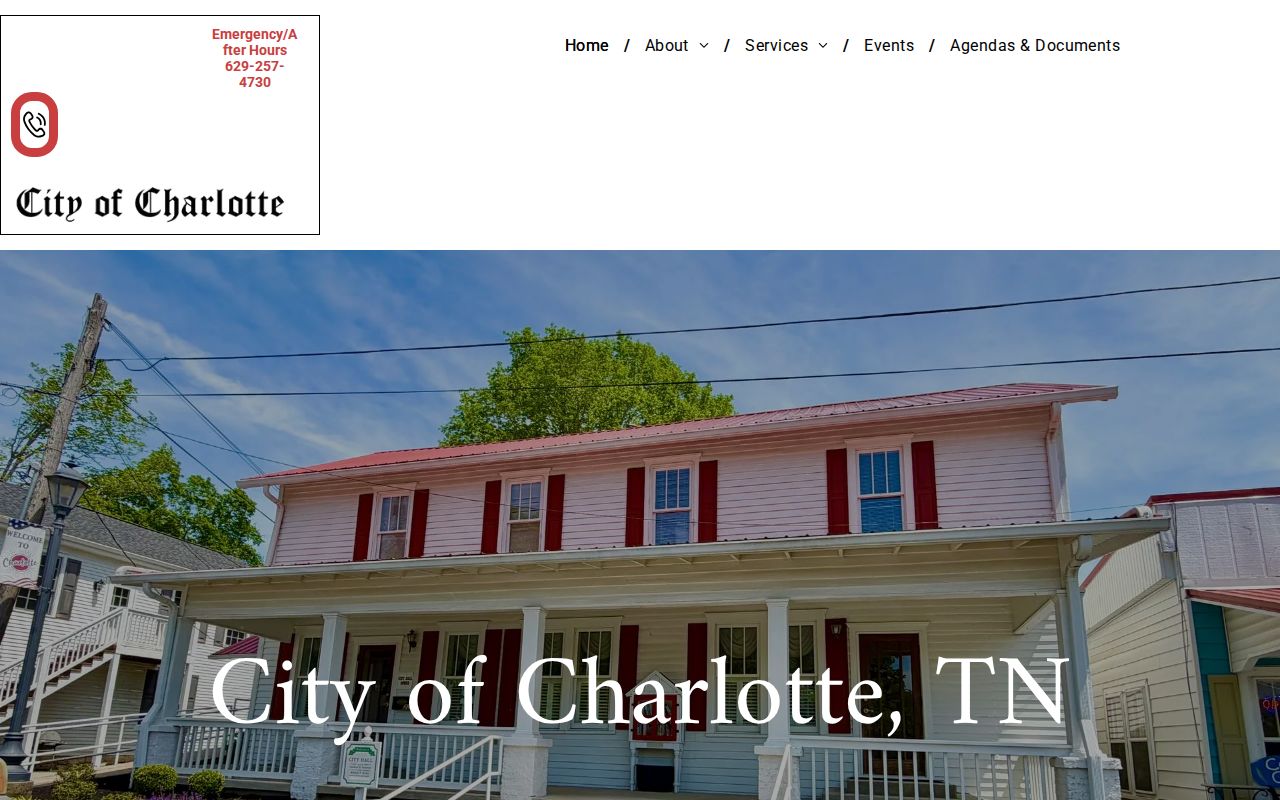
The city source supports the key boundary: Charlotte administrative files go to the Recorder, while criminal records follow the county offices identified by General Sessions and the sheriff.
If a caller needs definitive confirmation about a newly created city function or an unusual citation, City Hall can verify routing. That confirmation is safer than inventing a municipal court or city police office from Charlotte's status as an incorporated place.
Municipal Court Records in Charlotte
The official city and MTAS rosters reviewed do not list a Charlotte municipal judge or court clerk. Dickson County General Sessions expressly says it serves the City of Charlotte and publishes a Thursday municipal criminal docket. The best-supported conclusion is that Charlotte criminal court records use the county clerk route, not a separate city court portal. This remains a documented inference that should be confirmed with City Hall for an exceptional matter.
| Court Name | No separate Charlotte municipal court was identified; Dickson County General Sessions is the documented route. |
|---|---|
| Case Types Heard | General Sessions handles limited-jurisdiction criminal cases, early felony proceedings, and municipal criminal matters it serves. |
| Case Lookup Channel | General Sessions Clerk at 500 Spring Street, Charlotte; phone (615) 789-5414; no public web search was located. |
| What the Docket Shows | Complaint, case number, charge, bond action, appearances, hearing action, disposition, or bind-over when public. |
| Copies and Fees | Ask the clerk for the current copy process and cost before ordering; no Charlotte-specific fee was published. |
Do not send a Charlotte criminal docket request to the City Recorder merely because City Hall sits on Court Square. The current official evidence points to the county clerk.
Charlotte Warrant Records Run Daily
Four judicial commissioners support around-the-clock criminal-warrant availability in Dickson County. That does not create a public online Charlotte warrant search. It means judicial review and process can occur beyond the public clerk counter's weekday hours, while the record must still be confirmed through the sheriff and issuing court.
No official countywide active-warrant page was found. For Charlotte process, call the sheriff at (615) 789-4130 and the General Sessions or Circuit clerk connected to the case. Ask for the case or warrant number, charge, issue date, bond or hold terms, service status, and required appearance. An absent web result is not clearance.
Where Charlotte Records Go
Charlotte criminal records follow a county path from the start. The sheriff creates the report and the jail creates the booking after custodial intake. General Sessions receives the complaint and early docket. An indicted felony proceeds to Circuit Court. Fingerprint-linked arrest cycles and later dispositions are reported to the Tennessee Bureau of Investigation.
Record flow: Dickson County Sheriff in Charlotte › Dickson County Courts › Tennessee Bureau of Investigation
This flow differs from the template's usual city-police model because no Charlotte police portal is supported by the research. A recent event may be visible at the jail before court filing. The signed court judgment is the better source for the final outcome. TORIS supplies a name-based statewide result, but it is not the full Charlotte report or docket.
Charlotte Court Records Split
General Sessions and Circuit Court share the Justice Center address but keep different stages of a Charlotte case. General Sessions handles limited-jurisdiction criminal matters, early felony steps, bond and preliminary action, and many misdemeanor outcomes. Circuit Court handles felony and misdemeanor criminal files within its stated jurisdiction, indictments, later felony proceedings, and appeals from General Sessions and municipal courts.
The official General Sessions page identifies its Charlotte service and criminal schedule.
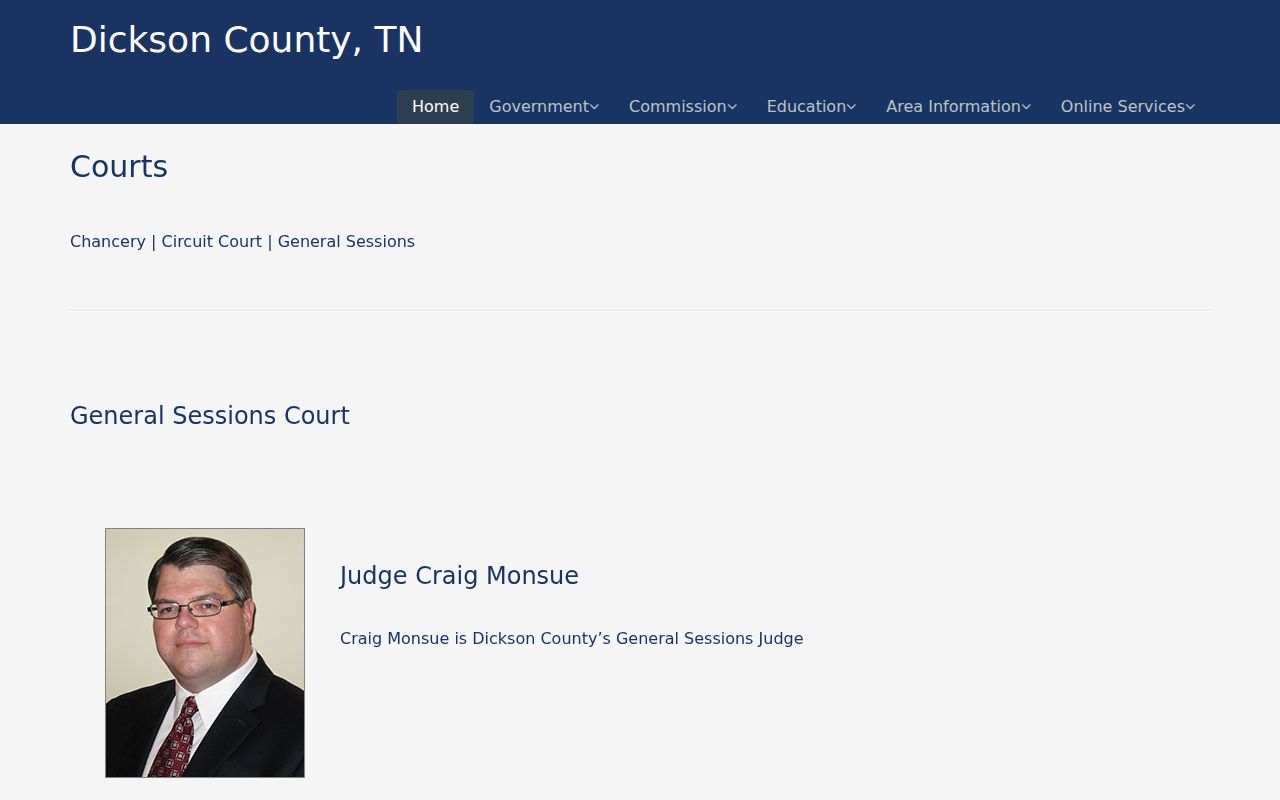
The county court image confirms the documented Charlotte route without implying that City Hall operates a separate criminal court.
For an older or felony file, ask which clerk holds the final action. Request the register of actions and signed judgment before ordering every page. The register is the chronological docket; the judgment states the outcome and sentence. The full county case route is described under Dickson County criminal court cases.
Charlotte Criminal Record Calendar
General Sessions publishes a Thursday 9:00 a.m. criminal municipal docket and a Friday 9:00 a.m. criminal county docket. It also lists Tuesday at 1:00 p.m. for probation-violation hearings. These schedules make Charlotte unusually transparent about recurring court settings, but calendars can change.
Call the clerk at (615) 789-5414 before travel. Ask which docket contains the Charlotte case, whether the setting remains active, and whether a document can be inspected or copied. The Circuit Clerk at (615) 789-7010 lists weekday hours from 8:00 a.m. to 4:00 p.m. for the felony and appellate file.
Public Access Rules in Charlotte
The Tennessee Public Records Act generally makes state, county, and municipal records open to Tennessee citizens unless a specific law protects them. For Charlotte sheriff records, inspection-only requests may be oral under the published policy. Requests for copies use the sheriff's Form 1. Court records are obtained from the clerk under judiciary record rules, not only through an executive-agency request.
Key Statutes:
Tenn. Code Ann. § 10-7-503 generally opens government records to Tennessee citizens unless another law creates an exception.
Tenn. Code Ann. § 10-7-504 protects confidential record categories and sensitive identifiers.
Tenn. Code Ann. § 37-1-153 generally makes juvenile court files confidential, subject to statutory exceptions.
Tenn. Code Ann. § 40-32-101 provides the starting authority for eligible Tennessee expungement.
Charlotte files may exclude active investigative facts, juvenile content, protected victim data, Social Security numbers, medical details, security procedures, and sealed or expunged records. Ask for the reasonably segregable public part when only a portion is protected.
Charlotte Record Geography Has History
Charlotte was incorporated in 1804 and developed around its courthouse and public square. The county describes its courthouse as Tennessee's oldest working courthouse and notes that Charlotte was once considered for the state capital. Modern criminal records, however, center on the Justice Center at 500 Spring Street and the sheriff and jail at County Jail Drive.
That timeline helps explain why the third-largest incorporated city holds the county's main justice offices. Charlotte's 2025 certified population was 1,656, far below the City of Dickson, yet county-seat status places the court, jail, sheriff, and district attorney within a small local area. Historical importance does not change custody rules. Older files may be routed through the clerk or County Archives, while current Charlotte criminal records stay with the agency and court that made them.