
Checking Criminal History in Dickson County
No single public database contains every Dickson County criminal record. Start with the event you need to verify. A recent custody question belongs with the county jail. A complaint, hearing, plea, or judgment belongs with General Sessions or Circuit Court. A city police narrative stays with the police department that wrote it. TORIS adds a Tennessee repository check, while FOIL covers people in current or former felony custody or supervision.
Gather a full legal name, known aliases, date of birth when the office permits its use, an approximate event date, and any case or booking number. Those facts help a clerk distinguish common names. They also reduce the risk of attaching a name-based state result to the wrong person. Use this order for a careful self-review:
- Call the jail for current custody or a recent booking number.
- Ask the arresting agency for its incident or arrest report.
- Check General Sessions for the complaint, bond, first setting, and lower-court result.
- Check Circuit Court if a felony was indicted or a lower-court matter was appealed.
- Order TORIS or use FOIL when a state repository or felony-supervision record is relevant.
Request the final signed judgment when an outcome matters. A current docket line may show only that a case is open, reset, or awaiting action.
Four Dickson County Record Custodians
Dickson County criminal records are divided by function. The sheriff holds sheriff-created reports, bookings, and jail status. General Sessions keeps limited-jurisdiction cases and early felony proceedings. Circuit Court maintains misdemeanor and felony files within its jurisdiction, indictments, appeals, judgments, and sentences. The Tennessee Bureau of Investigation compiles fingerprint-reported arrest cycles and dispositions received from justice agencies.
This split explains many failed searches. Asking the sheriff for a City of Dickson police narrative reaches the wrong custodian. Asking Circuit Court for a booking photograph does the same. The official Dickson County contact directory shows how the local offices are separated.
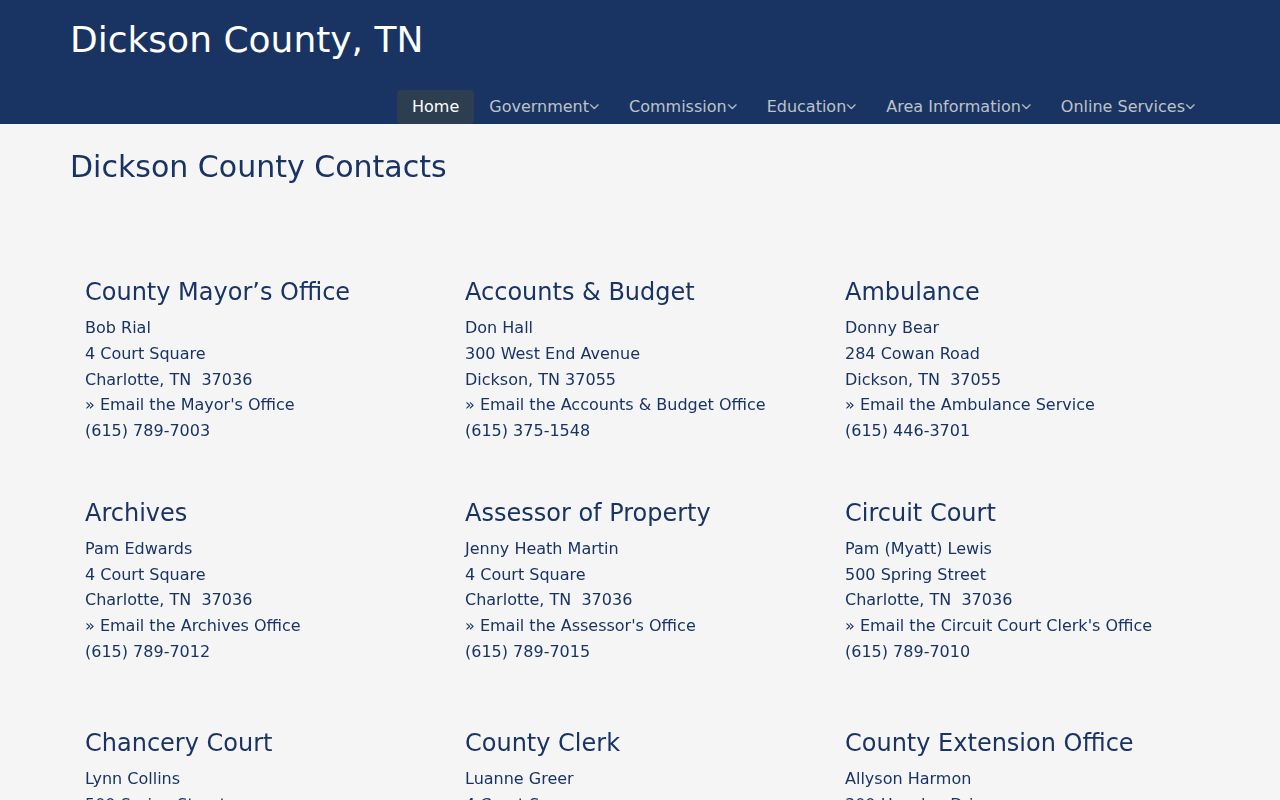
The directory is a useful routing aid, but the office holding the source record remains the place to confirm its contents.
Record flow: Arresting agency › county jail › General Sessions or Circuit Court › TBI repository.
Tennessee Official Background Checks
The Tennessee Bureau of Investigation Criminal Justice Information Services Division is the central state repository. Its Tennessee Open Records Information Services product, known as TORIS, lets any requester order a name-based Tennessee open-records check. The documented fee is $29 per request and is nonrefundable. The result searches identity data against Tennessee criminal history built from fingerprint submissions, but the search itself does not confirm identity by fingerprints.
A fingerprint-supported check is a different service. IdentoGO by IDEMIA captures prints for authorized Tennessee programs when the requesting program supplies its service code or authorization. The FBI Identity History Summary is also different: it is a subject's own nationwide fingerprint record, not a public lookup of someone else. Use official channels for any check required by law.
The TBI background-check overview shows the state's recognized options.
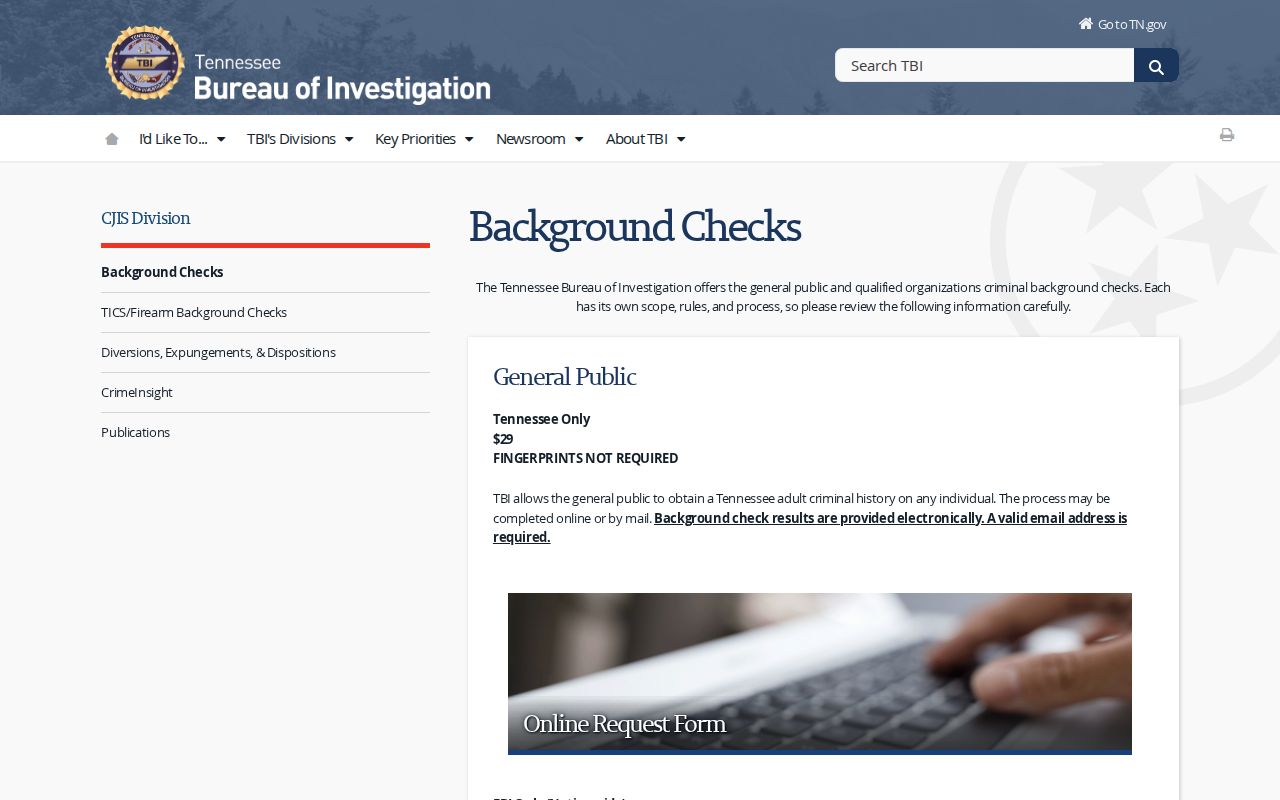
This state page helps separate an open-records name search from an authorized fingerprint check.
TORIS Criminal Records for Dickson County
TORIS works best when the identity fields are complete and exact. The paper application asks for legal first and last names, date of birth, race, sex, contact and delivery data, and payment details. Middle name, maiden name, aliases, and Social Security number can narrow a possible match when supplied through the secure official form. A result may still identify a possible matching Tennessee record rather than prove that the record belongs to a specific person.
The official TORIS ordering interface is the online start point.
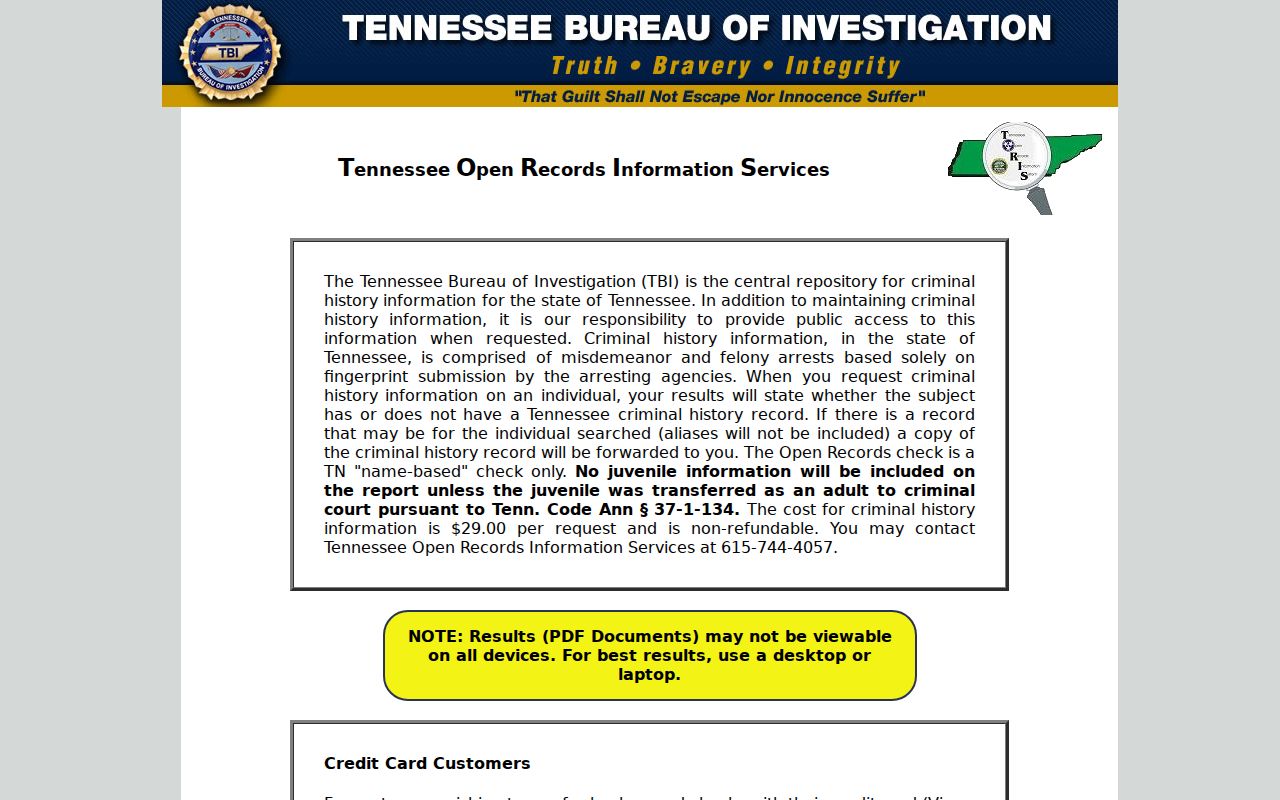
The ordering screen is for the TBI product, not the full police narrative or the clerk's case file.
| Field | Status | Why It Matters |
|---|---|---|
| First and last name | Required | Sets the core name-based search. |
| Date of birth | Required | Helps narrow people with the same name. |
| Middle or prior name | If known | Adds useful identity context. |
| Race and sex | Requested | Supports match review. |
| Requester and delivery data | Required | Directs return of the result. |
If a TORIS entry appears wrong, TBI directs the subject to submit locally obtained fingerprints with a dispute letter and the documented $24 fingerprint-comparison fee. Compare the result with the Dickson County disposition before starting that process.
Criminal Record Types
A Dickson County criminal history is a set of related records, not one fixed file. Each product captures a different stage. An arrest report describes the alleged event. The jail booking marks intake and custody. A clerk file shows what prosecutors filed and what the court decided. TORIS compiles reported state history. FOIL shows qualifying felony custody or supervision, and the Tennessee Sex Offender Registry serves a separate statutory public-safety purpose.
- Incident and arrest report: the creating agency's account of the allegation and response.
- Booking record: intake time, received charges, bond, holds, status, and release or transfer.
- Court case file: complaint, indictment, motions, appearances, plea or verdict, judgment, and sentence.
- Warrant or capias: court-issued process that must be confirmed with the issuing court or law enforcement.
- Repository or supervision entry: TBI or TDOC data with statewide scope but distinct limits.
An arrest proves that an agency took a person into custody. It does not prove guilt. Read the disposition for that answer.
Dickson County Criminal Records Hub
Most filed county criminal case records are centered in Charlotte, even though Dickson is the largest city. The Dickson County Justice Center at 500 Spring Street houses both criminal clerk channels. General Sessions can be reached at (615) 789-5414 and Circuit Court at (615) 789-7010. Both publish weekday hours from 8:00 a.m. to 4:00 p.m. The Circuit mailing address is P.O. Box 70; General Sessions uses P.O. Box 217.
The official county government gateway identifies the county offices and records structure.

That gateway leads to the clerk pages, while police and jail records remain with their own custodians.
General Sessions Court Clerk
500 Spring Street
Charlotte, TN 37036
(615) 789-5414
Monday through Friday, 8:00 a.m. to 4:00 p.m.
Circuit Court Clerk
500 Spring Street
Charlotte, TN 37036
(615) 789-7010
Monday through Friday, 8:00 a.m. to 4:00 p.m.
General Sessions publishes probation-violation matters on Tuesday afternoons, municipal criminal court on Thursday mornings, and county criminal court on Friday mornings. Schedules may change, so call before a visit.
Inside a Dickson County Criminal Record
The useful fields depend on the source. A booking record focuses on intake. A court record tracks prosecution. A repository result links fingerprint-reported arrest cycles to dispositions that agencies sent to TBI. Read the source label first, then check whether the event date, filing date, disposition date, and sentence date describe the same stage.
| Name and Identifiers | Legal or display name, aliases, date of birth where public, and agency or case identifiers. |
|---|---|
| Arrest and Booking | Arresting agency, event date, booking number, received charges, bond, holds, and release or transfer. |
| Charges and Statutes | Count, offense text, legal citation, class, amendments, and filing dates. |
| Disposition | Conviction, dismissal, acquittal, nolle prosequi, no bill, or another recorded outcome per count. |
| Sentence | Confinement, probation, costs, fines, restitution, jail credit, and concurrent or consecutive terms. |
| Custody or Supervision | Current location, probation, parole, inactive status, release data, or other TDOC status when applicable. |
- Disposition
- The court's recorded result for one charge.
- Nolle prosequi
- A formal decision by the prosecution not to continue the charge at that time.
- True bill
- A grand jury's decision that probable cause supports an indictment.
- Capias
- Court process directing that a person be taken into custody, often after a failure to appear or comply.
Dickson County Jail and FOIL Records
The Dickson County sheriff does not publish an official public jail-roster interface. For a recent booking, call the jail at (615) 789-4109 and ask by full legal name plus a booking number or date of birth when staff permits. Confirm whether the person is housed, released, transferred to TDOC, or held elsewhere. A public booking record, if released, may show intake, bond, charges, holds, court, and status, but not the final result.
FOIL becomes useful after a felony sentence or transfer enters TDOC scope. It can show a photograph, TOMIS ID, status, location, offense, sentence, parole-hearing information, and release data. It does not cover every Dickson County misdemeanor or recent arrest. The official TDOC FOIL search shows the state felony-offender fields.
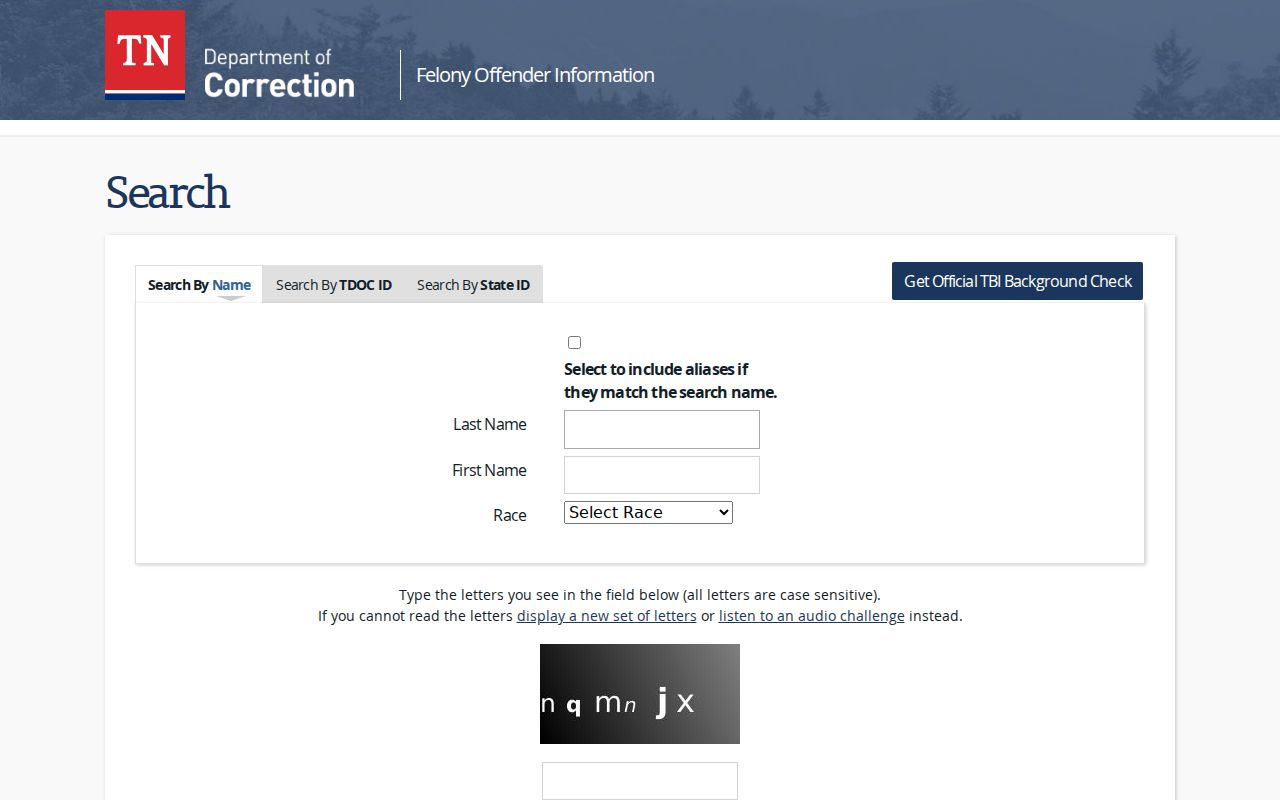
The interface accepts a name or an available TOMIS or state identifier, making it a custody and supervision check rather than a county court search.
| Need | Best First Source | Limit |
|---|---|---|
| Recent county booking | Dickson County Jail phone | No final court outcome |
| Custody notification | VINE or VINELink | Notification is not a judgment |
| Felony prison or supervision | TDOC FOIL | Not a full local arrest history |
Public Access Laws in Tennessee
The Tennessee Public Records Act generally opens state, county, and municipal records to Tennessee citizens unless another law makes the material confidential. The rule concerns existing records. It does not require an office to create a new report or answer research questions. Court records also follow judiciary rules and should be requested from the clerk, while police records go to the agency that created them.
Key statutes:
Tenn. Code Ann. § 10-7-503 generally opens government records to Tennessee citizens unless an exception applies.
Tenn. Code Ann. § 10-7-504 protects listed confidential records and identifying details.
Tenn. Code Ann. § 37-1-153 generally keeps juvenile court records confidential, subject to statutory exceptions.
Tenn. Code Ann. § 40-32-101 supplies the starting authority for qualifying expungement.
Tenn. Code Ann. §§ 40-39-201 through 40-39-218 govern Tennessee sex-offender registration and public access.
Active investigative material, protected victim details, medical data, security information, sealed records, and personal identifiers may be withheld or redacted. Ask for the reasonably separable public part when only some content is protected.
Dickson County Sheriff's Record Requests
The sheriff's Public Records Request Coordinator is Barbara Poppendorf, P.O. Box 177, Charlotte, TN 37036. The records line is (615) 740-4854, the fax is (615) 789-4185, and the published email is RecordsRequests@dicksoncosheriff.gov. An inspection-only request may be oral. A request for copies, or inspection plus copies, must use the written form. Proof of Tennessee citizenship may be required under the published policy.
Describe the existing record with a date range, location, involved name, incident or booking number, and record category. Ask for a cost estimate and available delivery method. When prompt production is not practical, the custodian uses a response form within seven business days to explain review, redaction, retrieval, or uncertainty and to give a reasonable production time.
| Item | Published Rule |
|---|---|
| Inspection | Free at the place and time set by the custodian; personal copying equipment is barred by policy. |
| Black-and-white letter or legal copy | $0.15 per page; the policy states no color copying. |
| Other media | Actual county reproduction cost. |
| Labor | Charged after the first 15 minutes. |
| Advance payment | Required when the estimate exceeds $10. |
Request the sheriff's own incident report, booking sheet, dispatch record, warrant confirmation, or releasable media. A city police report and a clerk's case file need separate requests.
Sealed, Expunged, and Restricted Records
Juvenile information, active investigative content, protected victim data, Social Security numbers, financial account data, and sealed or expunged material are not ordinary public search content. TORIS excludes routine juvenile history unless the juvenile was transferred for adult criminal treatment. A missing result can therefore reflect a legal restriction, an agency reporting delay, an unmatched disposition, or a search at the wrong office.
For Dickson County expungement, first obtain the final disposition and case number from the clerk that closed the case. Use the current Tennessee judiciary form, file it in that court, ask whether a fee applies, and follow the form's routing instructions. Eligibility depends on the precise outcome and offense. An acquittal, dismissal, nolle prosequi, no true bill, or certain arrests without charges may have a different route from a petition involving an eligible conviction.
After a valid order reaches TBI, the agency removes the covered state entry and fingerprint material and sends required action to the FBI. Recheck the clerk record and order your own TBI result after processing. If a covered charge remains, use the certified order with the reporting agency and TBI correction channel.
Dickson County Warrant Record Fallback
No official countywide active-warrant search page was located for Dickson County. That makes the source chain more important. Call the sheriff at (615) 789-4130, contact the General Sessions or Circuit clerk tied to the case, and check the issuing municipal court for a city warrant. A bench warrant or capias caused by a missed setting may appear first in the issuing case rather than in a public list.
Ask for the case or warrant number, issuing court, issue date, charge, bond or hold terms, service status, and the next required action. Do not treat the absence of a name from an unofficial search as clearance. Only the court or responsible law-enforcement agency can confirm current status. If a warrant appears to involve you, counsel can contact the clerk about scheduling and a safe resolution before any in-person step.
Note: Sealed process, juvenile matters, and active investigative records may remain unavailable even when the issuing office confirms the correct search channel.
Dickson County Criminal Records by City
The three largest incorporated cities by certified 2025 population are Dickson, White Bluff, and Charlotte. Their record routes differ. City of Dickson and White Bluff keep municipal police or court channels, while Charlotte's criminal enforcement and court records are best supported as county-routed. The city guides keep that local first step distinct from the county jail, county courts, and state repository.
Dickson Criminal Records
Population 16,058. City police reports begin with Dickson Police, while bookings and county cases move to Charlotte.
White Bluff Criminal Records
Population 3,862. Town police and court records remain distinct from county jail and prosecution files.
Charlotte Criminal Records
Population 1,656. County sheriff and court offices provide the supported criminal-record route for the county seat.
Fingerprints in Dickson County Criminal Records
Fingerprints connect a local arrest cycle to the TBI repository. The arresting agency writes the report, and jail intake creates the booking record, fingerprints, photograph, received charge list, bond, and holds. TBI uses fingerprint submissions to establish or update the state-linked arrest cycle. Later, clerks and justice agencies report the disposition. A time gap at either step can make two official sources appear to conflict.
The Tennessee IdentoGO location gateway shows appointment access for authorized program checks.
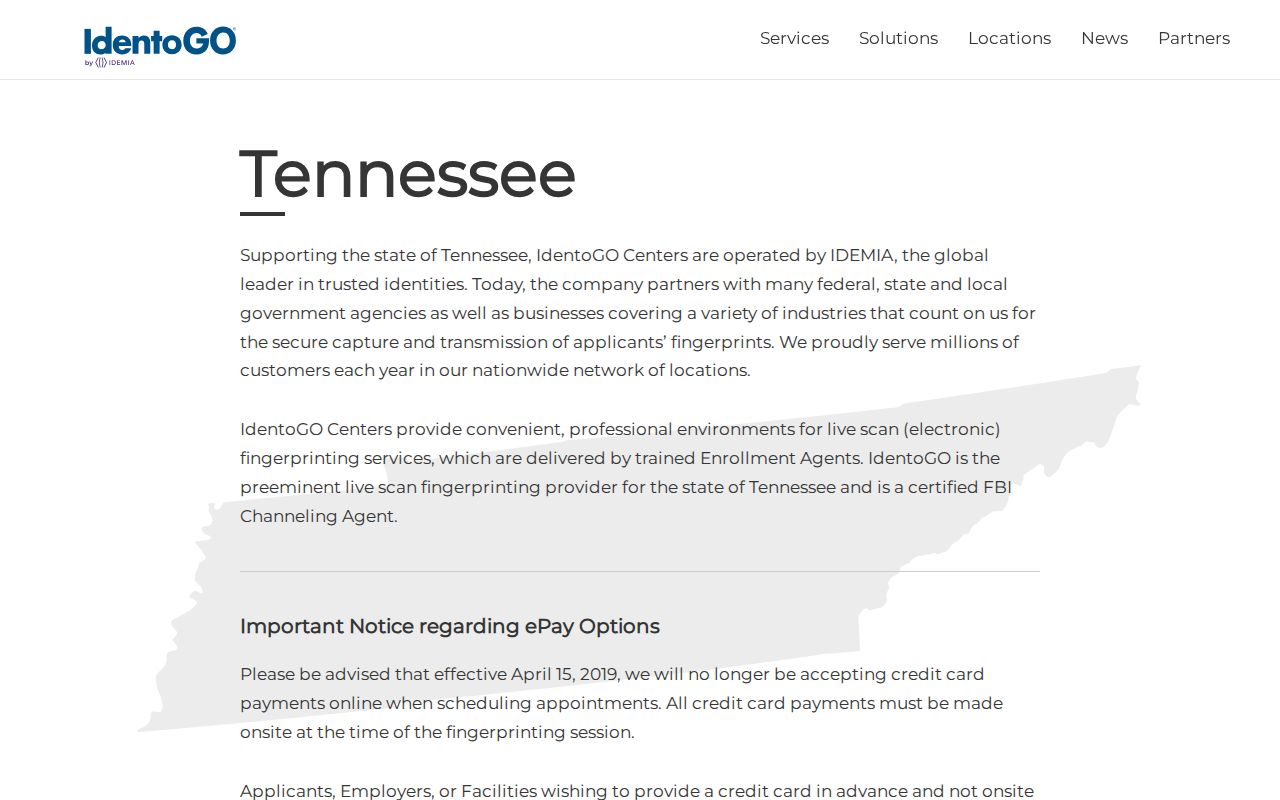
Its service-code workflow should not be confused with the separate fingerprint process TBI prescribes when a subject disputes a TORIS result.
The official TBI CrimeInsight dashboard provides agency and county crime statistics rather than individual histories.
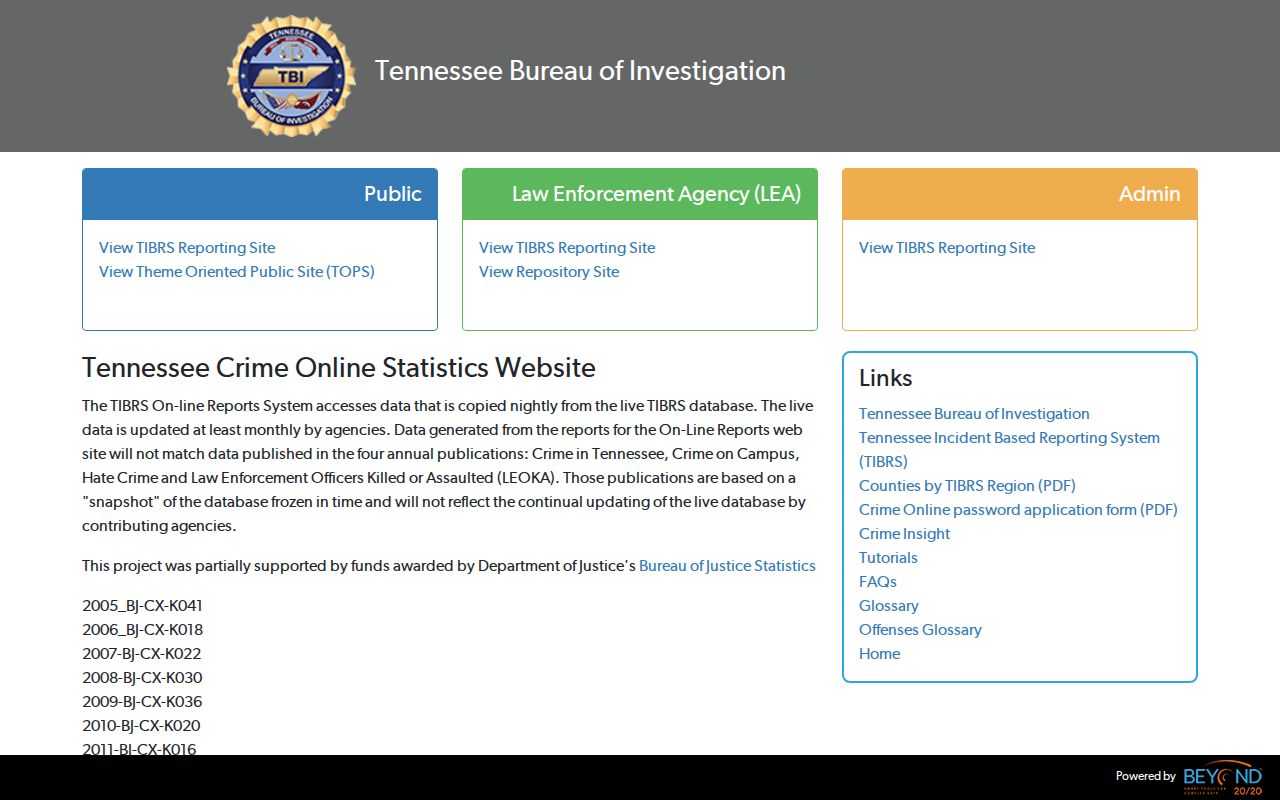
Use a named reporting year and agency when reading those totals, since county and city data do not describe the same jurisdiction.