
Dickson County Criminal Court Cases
Dickson County criminal court cases do not sit in one public database. The General Sessions Court handles limited-jurisdiction criminal matters, preliminary felony work, probation violations, and criminal dockets tied to county and municipal process. A misdemeanor may end there. A felony often begins there with a complaint, bond action, and preliminary proceedings before it moves to a grand jury.
The Dickson County Circuit Court Clerk maintains misdemeanor and felony case files as well as appeals from General Sessions and municipal courts. Circuit Court is the key source after an indictment. Municipal courts retain city ordinance, citation, and locally issued process within their own jurisdiction. Chancery Court is in the Justice Center too, but its civil and probate work does not make it the normal criminal-record counter.
Dickson Criminal Cases: Which Clerk?
The fastest way to route a Dickson County criminal case is to ask what event has occurred. General Sessions is the likely first stop for a recent complaint, first appearance, bond entry, preliminary hearing, or county misdemeanor. Circuit Court is the likely stop for an indictment, felony plea, trial, final judgment, sentence, or appeal from a lower court. A city citation may still require a municipal court call before either county clerk can help.
| Record clue | Best first office | What to request |
|---|---|---|
| New complaint or first appearance | General Sessions | Complaint, bond, next date |
| County misdemeanor | General Sessions | Docket and final disposition |
| Felony indictment | Circuit Court | Indictment, register of actions, judgment |
| Municipal citation or warrant | Issuing city court | City docket and status |
The source image from the official Circuit Court page shows the local clerk duties and contact channel.
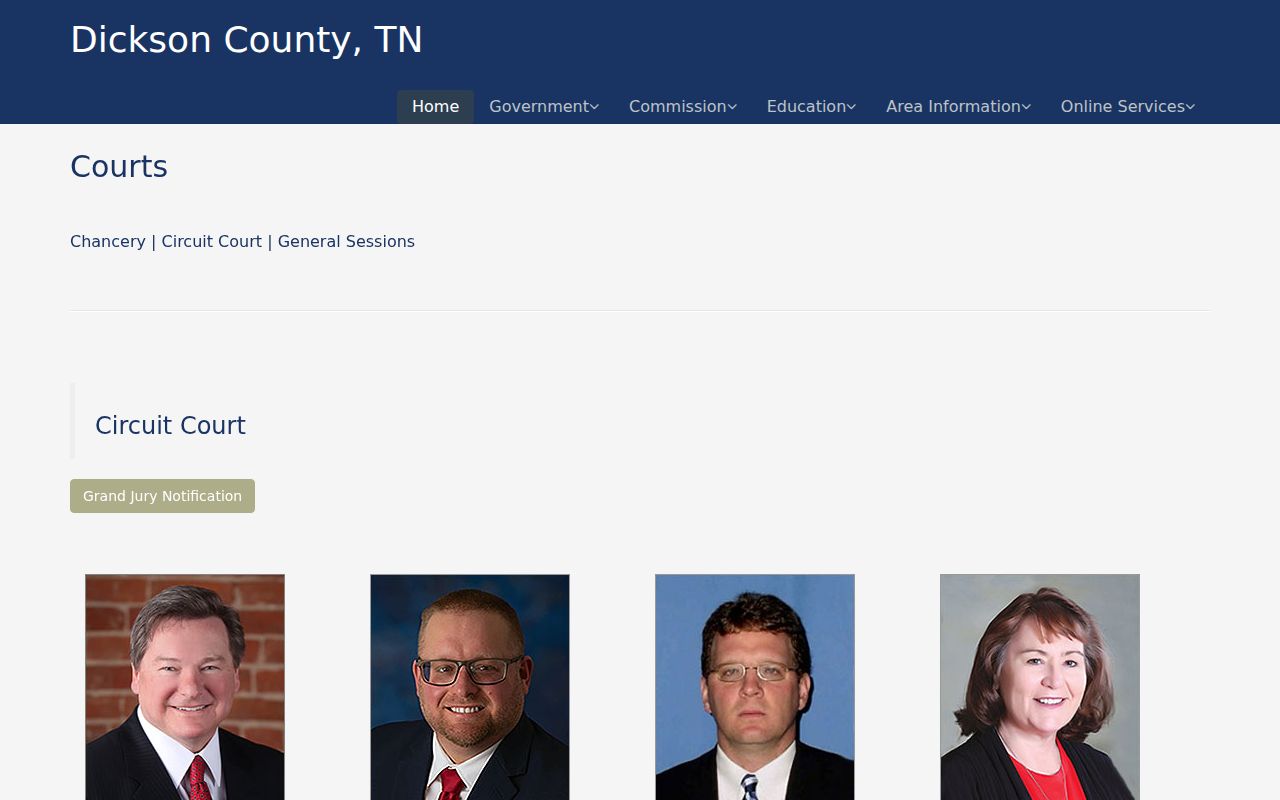
That office description confirms why a filed Dickson County felony record belongs with the court clerk rather than the sheriff or jail.
Searching Dickson County Case Records
No public web portal was located for Dickson County trial-court dockets, and Tennessee does not provide a free, unrestricted statewide trial-court name search. Use the Dickson County clerk chain instead. Start with a case number when known. A full legal name, a rough filing or arrest date, and the court level can help staff distinguish similar names. Ask whether the Dickson County clerk can provide a register of actions before ordering the full file.
- Call General Sessions at (615) 789-5414 for a lower-court case, early felony action, or probation-violation docket.
- Call Circuit Court at (615) 789-7010 when an indictment, felony disposition, sentence, or lower-court appeal is likely.
- Give the full legal name, known case number, and a date range. Ask what other identifier the clerk permits.
- Request the docket or register of actions, then identify the complaint, indictment, orders, and judgment actually needed.
- Ask about inspection, mail delivery, certification, payment, and redaction before placing a copy order.
| Search detail | Format | Use | Limit |
|---|---|---|---|
| Full name | Legal spelling | Primary clerk index | May match more than one person |
| Case number | Court-assigned value | Most direct file key | Must match the right court |
| Date range | Approximate filing period | Narrows an offline search | Not a substitute for identity |
| Case level | Municipal, Sessions, Circuit | Routes the request | A felony may cross levels |
Older Dickson County Case Files
If a clerk name search misses an older Dickson County criminal case, do not assume the file never existed. Ask whether the record is still onsite, stored under an earlier case-number format, or transferred to an archive. The Dickson County Archives is at 4 Court Square in Charlotte and can help route older transferred county holdings, but the responsible court clerk may still retain the criminal file or index.
Describe the record, not a question the office must research. Give a date span, charge or case type if known, prior names, and the court that likely heard the matter. For a city matter, also contact the issuing municipal court. A Tennessee Public Records Act request can seek existing public records, but court access also operates under judiciary records rules. The clerk remains the sound first source for a court file.
Dickson County case research can also split across offices when a lower-court decision was appealed. Ask the Dickson County General Sessions clerk for the original docket and the Dickson County Circuit clerk for the appeal record. If the file was expunged or sealed, neither an empty name result nor a clerk's limited response should be treated as proof that no proceeding occurred. The Dickson County clerk can explain which public index or order may still be released.
Note: Call before traveling because courthouse security, device, copying, and accommodation details were not published in the reviewed county material.
Inside a Dickson County Case File
A Dickson County criminal court file tracks prosecution, not just arrest. The header identifies the court, case number, filing date, status, and assigned judge. Each count may show its legal description, statute, offense class, relevant dates, and later amendment. The docket then records hearings, pleadings, motions, orders, plea or trial events, judgment, sentencing, probation issues, and appeal activity.
| Case number and court | Identifies the file, division, filing date, type, status, and assigned judge. |
|---|---|
| Charging document | May be a complaint or indictment and can differ from the arresting agency's first charge. |
| Docket entries | Lists appearances, waivers, motions, hearings, orders, pleas, trial steps, and appeal events. |
| Bond and process | May show warrant or capias entries, service, returns, bond amount, type, and conditions. |
| Disposition and judgment | Records the result for each count, including dismissal, plea, conviction, acquittal, or no bill where applicable. |
| Sentence and finance | May show confinement, jail credit, probation, concurrent or consecutive terms, costs, fines, and restitution. |
Ask for the final signed judgment when the outcome matters. A current docket status can lag a signed order, and one count may end differently from another.
Dickson County Criminal Docket Terms
Short docket terms can change the meaning of a Dickson County case. A disposition is the result of one Dickson County charge, not always the whole case. A grand-jury action determines whether the proposed felony count proceeds by indictment. Bond concerns release and appearance conditions; it is not a finding of guilt. Read the Dickson County entry beside its date and document rather than guessing from one word.
- Nolle prosequi
- The prosecution formally declines to continue a charge at that time.
- True bill
- The grand jury returns an indictment after finding probable cause.
- No bill
- The grand jury declines to indict the presented charge.
- Capias
- Court process directing that a person be taken into custody, often after failure to appear or comply.
- Disposition
- The outcome of a count, such as dismissal, acquittal, plea, or conviction.
How a Criminal Case Moves
A local prosecution may start with a sworn complaint in General Sessions. A misdemeanor can resolve there. A felony may receive preliminary action, move to the grand jury, and reach Circuit Court after indictment. The district attorney can change, add, decline, or dismiss counts, so arrest charges and filed charges may not match.
Charges Filed → Arraignment → Pretrial → Plea or Trial → Disposition → Sentencing
At arraignment, the charge is stated and a plea is entered. Pretrial entries may include discovery issues, motions, and scheduled hearings. A plea or trial leads to a result on each count. Sentencing follows a conviction, while a dismissal, acquittal, nolle prosequi, or no bill produces a different ending. The broader Dickson County arrest lookup explains why the earlier booking record remains a separate document.
Dickson County dates should be read in sequence. The arrest date, complaint date, indictment date, judgment date, and sentence date may all differ. A Dickson County docket entry labeled open or pending describes a point in that sequence, not the final result. When the Dickson County case has ended, request both the per-count disposition and the signed judgment so later changes to the original allegation are clear.
Dickson County Grand Jury Cases
Dickson County publishes a formal grand-jury notice through the Circuit Clerk. It lists convening dates and cites Tenn. Code Ann. § 40-12-105, which concerns information about a public offense. For record research, the key point is procedural: a true bill creates the indictment that moves a felony prosecution into Circuit Court, while a no bill means the grand jury declined to indict the presented charge.
The notice does not turn secret grand-jury evidence into a public case file. Ask the Circuit Court Clerk for the public indictment, docket, and later judgment. Grand-jury material, sealed documents, and protected witness or victim information may remain unavailable even when the resulting court case is public.
Case Record Access and Restrictions
Dickson County court files are generally accessed from the clerk, subject to court rules and statutory limits. Juvenile court records are ordinarily confidential. Sealed or expunged material, Social Security numbers, financial-account data, protected addresses, and sensitive victim or minor information are not part of ordinary public access. A public Dickson County copy may therefore omit fields that exist in the court's secured record.
The Tennessee Public Records Act generally opens state, county, and municipal records to Tennessee citizens unless an exception applies. Yet an executive-agency request is not the only path to a judicial record. Ask the Dickson County clerk what can be inspected, copied, or certified. If a file cannot be released in full, ask whether a redacted public portion or public docket remains available.
Federal Dickson County Criminal Cases
Federal prosecutions from Dickson County do not sit with either local clerk. The U.S. District Court for the Middle District of Tennessee is the relevant federal trial court. Its official site image marks that separate court system.
A federal docket may show an indictment, appearances, motions, minute entries, judgment, and available documents. Sealed filings and grand-jury material remain restricted.
Electronic federal dockets are obtained through PACER, which requires registration and applies the judiciary's current fee rules. The official PACER image shows the access service used for those records.
Search by court, party, case number, filing range, or case type. PACER is not a substitute for the Dickson County clerks when the prosecution was filed in Tennessee state court.